High-pressure laminate (HPL) and compact laminate are born of the same technology — but they differ in thickness, substrate needs and where they belong. The wrong choice returns as swelling in a wet area or early wear under heavy traffic. This guide walks through the difference, the performance characteristics, and which one fits which space.
What is HPL (High-Pressure Laminate)?
HPL is a thin surfacing layer (typically 0.5–1.5 mm) made by topping resin-impregnated kraft-paper layers with a decor paper and a protective overlay, then pressing under high heat and pressure. It is not self-supporting; it is bonded to a substrate such as chipboard or MDF. It is common on furniture surfaces, cabinet doors, shelves and decorative wall cladding. Its performance is defined by EN 438.
What is compact laminate?
Compact laminate is the thick (usually 2–20 mm), self-supporting form of the same kraft + resin structure, pressed with many more layers. It needs no separate substrate; both faces are decorative and the core is usually dark (black/brown) or coloured. Being non-porous, dimensionally stable and resistant to moisture and impact, it is the first choice for wet and high-traffic areas. Interior compact references EN 438-4, and exterior cladding references EN 438-6.
Compact laminate vs. HPL: a comparison
| Property | HPL | Compact Laminate |
|---|
| Thickness | 0.5–1.5 mm | 2–20 mm |
|---|
| Substrate | Required (chipboard/MDF) | Not required (self-supporting) |
|---|
| Build | Single decorative face + substrate | Double-sided decor, solid core |
|---|
| Moisture behaviour | Depends on substrate; edge protection matters | Non-porous, suited to wet areas |
|---|
| Typical use | Furniture, cabinetry, decorative cladding | WC cubicles, lab worktops, facades |
|---|
| Edge look | Edge-banded | Solid (core colour visible) |
|---|
Performance: which load, which surface?
The right choice starts with reading the load the surface will face:
- Moisture & water: Compact laminate is non-porous and dimensionally stable; it works without swelling in wet areas such as WC cubicles, showers and labs. With HPL, the substrate and edge detail are decisive.
- Chemicals: The surface resists everyday cleaning agents and many lab reagents; with aggressive chemicals, contact time and concentration matter (verify with the manufacturer’s resistance table).
- Impact & wear: High surface hardness and scratch resistance for high-traffic public spaces.
- Heat: The surface withstands short-term heat; use a trivet for hot pots/objects and avoid a direct, prolonged heat source.
- Hygiene: The non-porous body won’t hold liquids or microorganisms and suits daily disinfection — an advantage in healthcare and food areas.
- Fire behaviour: Flame-retardant options are available per project; public buildings require the relevant documentation.
Choosing by application
- WC compact cubicles, shower partitions: compact laminate — wet area + self-supporting.
- Laboratory & hospital worktops: chemical-resistant compact → G-Lab worktops.
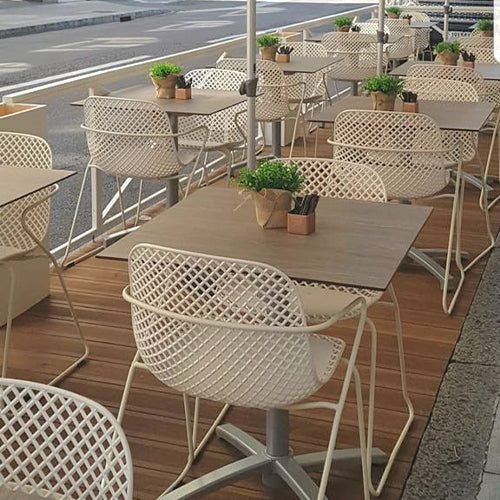
- Compact table tops: impact- and moisture-resistant compact for cafés, restaurants, schools and outdoors.
- Exterior facades: UV- and weather-resistant exterior panel → G-EXT.
- Furniture, cabinetry, interior decor: HPL on a substrate.
5 questions for choosing the right surface
- Will the surface get wet? (If yes, lean toward compact.)
- Must it be self-supporting, or will it bond to a body?
- Which chemicals will it meet, and how often?
- Interior or exterior? (Exterior demands a UV-resistant panel.)
- Any hygiene or fire requirement? (Healthcare, education, public projects.)
How to write it into a specification
Specifying HPL or compact laminate only by product name is weak. A useful technical specification defines the application, panel thickness, surface type, hygiene/fire requirement, edge detail, fixing system and document pack. For a WC cubicle, for example, define thickness, hinge/foot fixings, edge chamfer, wet-area suitability and cleaning-chemical resistance.
Common selection mistakes
- Using interior HPL outdoors: exterior panels must be assessed for UV, rain, freeze-thaw and temperature cycling.
- Assuming HPL is water-resistant as a system: the surface is durable, but the substrate and edges can fail if left exposed.
- Choosing thickness by price only: span, fixing points and traffic level directly affect compact-panel thickness.
- Generalising chemical resistance: ask which chemical, concentration and contact time apply.
Why edge, hole and installation details matter
Compact laminate needs no edge banding, but edge chamfer, hole centres and fixing distances must be planned. With HPL-faced boards, edge banding, adhesive quality and a balancing backer affect service life. For table tops, cabinet fronts and worktops, CNC cutting and hole planning are part of performance.
In short
Compact laminate leads in wet, high-traffic areas; HPL leads on substrate-backed decorative surfaces. For made-to-measure sizing, cutting and forming see our CNC services; for product families see G-Lab and G-EXT.
Sources
#compact laminate
#HPL
#high pressure laminate
#surface selection
#EN 438
 Plate & Panel Products
Manufacturer
Plate & Panel Products
Manufacturer

 ®
®