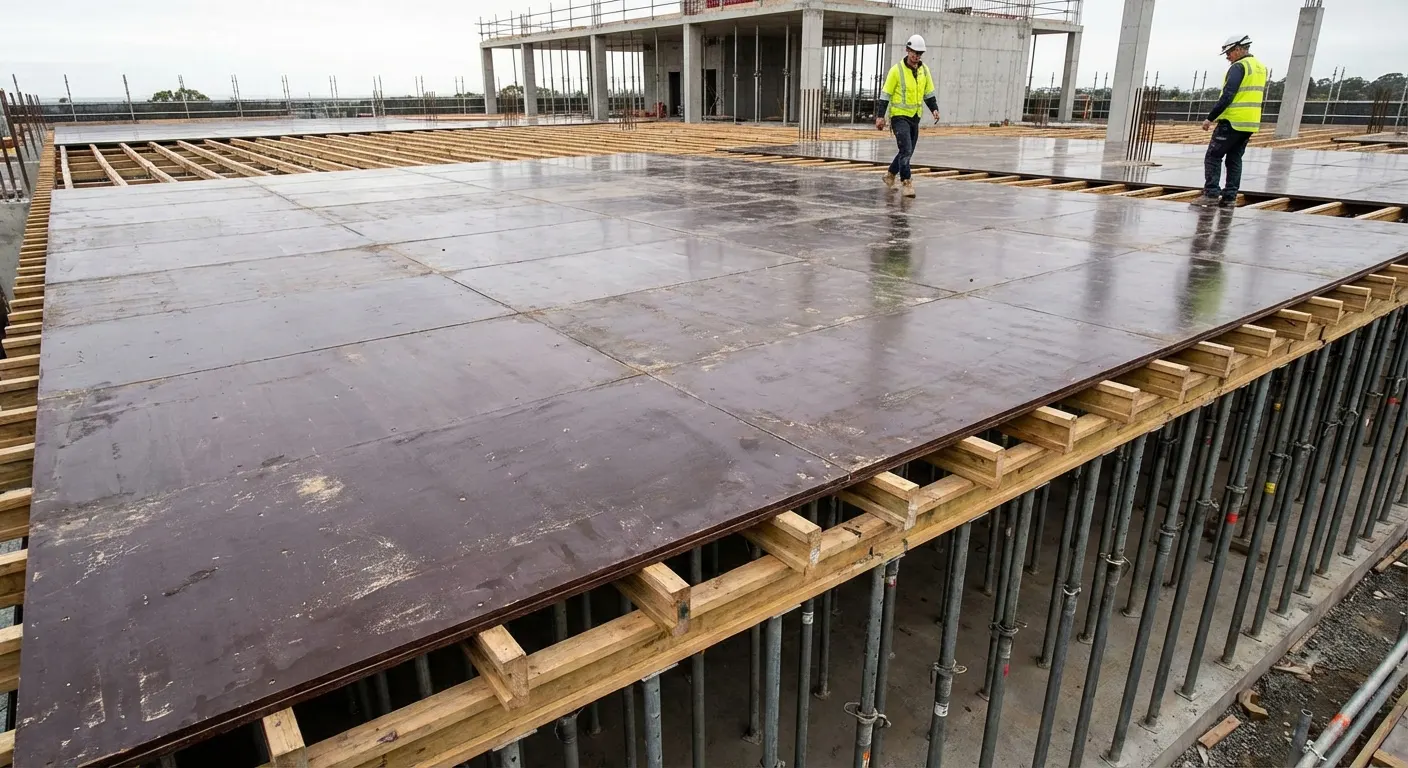
Film-faced plywood is a phenolic-film-coated panel used in concrete formwork for a smoother finish, moisture resistance and reuse. When the right panel is chosen, it improves not only the concrete surface but also labour time and total cost per square metre.
What is film-faced plywood?
A phenolic-resin film is applied to both faces of the panel; the core is usually birch, poplar, combi or hardwood veneers. The film smooths the concrete-contact surface, reduces water absorption and makes cleaning after stripping easier. Protecting the edges with paint or sealant is decisive for panel life.
Selection criteria: do not look only at thickness
| Criterion | Why it matters | Check question |
|---|
| Core quality | Affects voids, deflection and screw holding. | Are plies tight and void-free? |
|---|
| Film quality | Defines concrete finish and cleanability. | Is film weight and surface type stated? |
|---|
| Adhesive | Prevents delamination in wet, alkaline concrete conditions. | Is phenolic/WBP performance documented? |
|---|
| Edge sealing | Edges absorb the most water. | Are cut edges re-sealed? |
|---|
| Maintenance | Directly affects reuse cycles. | Is there a stripping, cleaning and storage procedure? |
|---|
5 practices that increase reuse
- Re-seal cut edges on site.
- Keep nails and screws away from panel edges.
- During stripping, direct lever force to supporting points, not the film face.
- After each pour, clean without scraping the film surface; use suitable release agent and soft tools.
- Stack panels flat, protected from water and long exposure to direct sun.
Market direction: from cheap panel to total cost
Recent supplier blogs and site notes show the decision moving from “sheet price” to “how many pours, how much surface finishing does it save, and is supply continuous?” With correct use, a higher upfront panel cost can be balanced by lower cost per use.
Common mistakes on site
Performance loss in film-faced plywood often comes from handling, not only from panel quality. The most common mistake is failing to re-seal edges after cutting. Factory edges may be protected, but every site cut creates a new exposed edge. Once that edge absorbs water, the film face may still look acceptable while swelling or delamination starts in the core.
The second mistake is applying crowbar and hammer force directly to the film surface during stripping. Once the film is scratched, concrete water and alkalinity can reach the core more easily. The third mistake is storing panels on wet ground, under rain or leaning unevenly for long periods. Because plywood is layered, flat and dry storage is part of reuse performance.
How to read quality class
“18 mm” alone is not a specification. Two panels with the same thickness may perform very differently because of core density, ply count, adhesive type, film weight, pressing quality and edge protection. Birch core is heavier and stronger; poplar core can be lighter and more economical. Combi cores balance the two. Formwork load, pour frequency, surface expectation and handling should be evaluated together.
Which panel approach fits which job?
| Application | Priority | Panel approach |
|---|
| Small one-off formwork | Economy | Economical core with proper edge protection |
|---|
| Repeated wall/column pours | Reuse | Better film, tight core, disciplined maintenance |
|---|
| Architectural concrete finish | Surface quality | High-quality film and undamaged face |
|---|
| Humid site conditions | Water resistance | Phenolic adhesive and strong edge sealing |
|---|
What to check in a sample
Gloss or colour is not enough to judge a sample. Look at ply tightness, voids, film bond and edge sealing in the cross-section. If possible, test screw holding, edge cutting and short water exposure on a small piece. In larger purchases, compare delivered panels against the approved sample at receiving.
For project-suitable plywood and laminate panel options see Gülmar Panels and Plates; for custom cutting see our CNC services.
Sources
#film faced plywood
#formwork plywood
#phenolic film
#concrete formwork
#plywood
 Plate & Panel Products
Manufacturer
Plate & Panel Products
Manufacturer

 ®
®